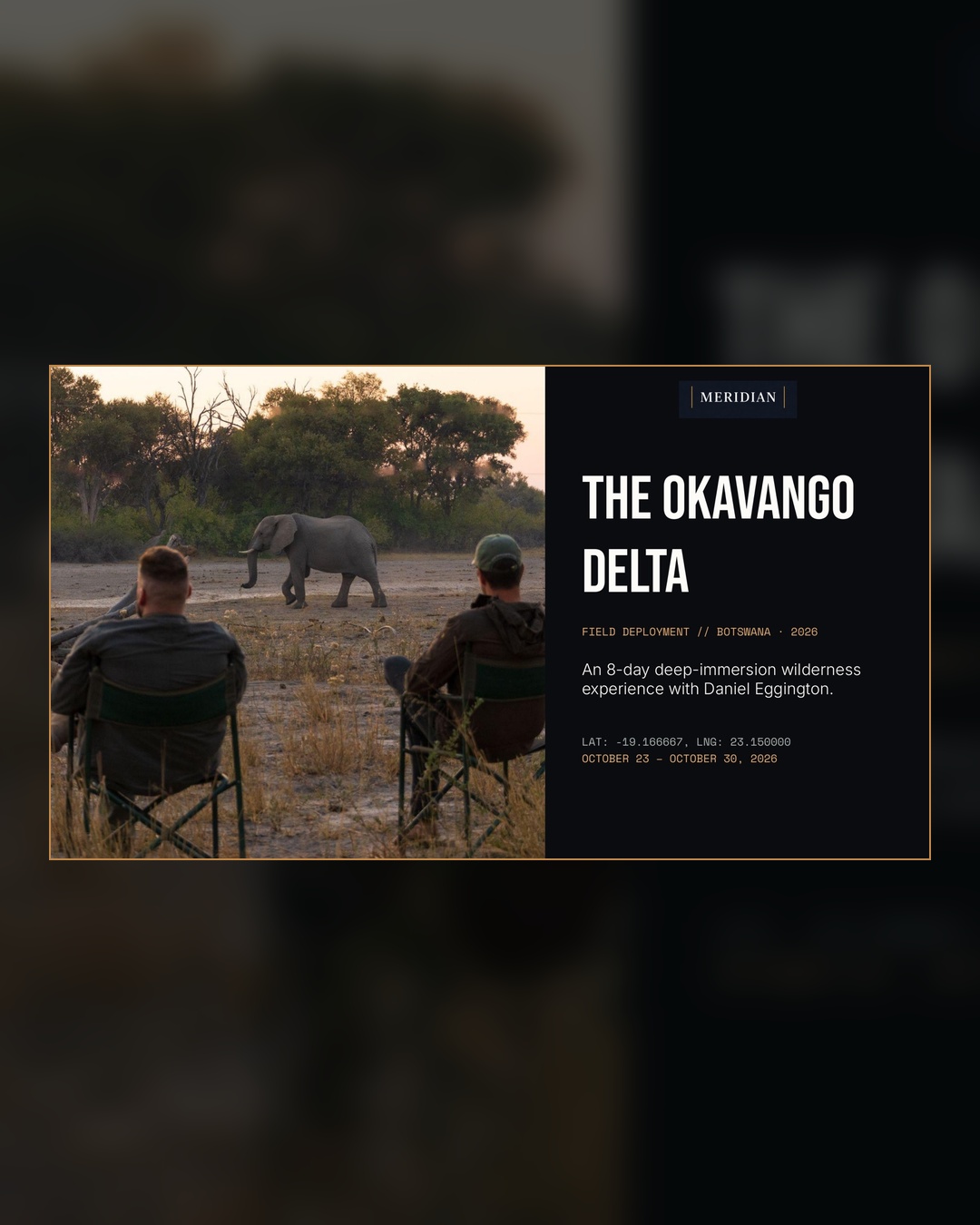
The Okavango
Delta
An 8-day deep-immersion wilderness experience with explorer Daniel Eggington.
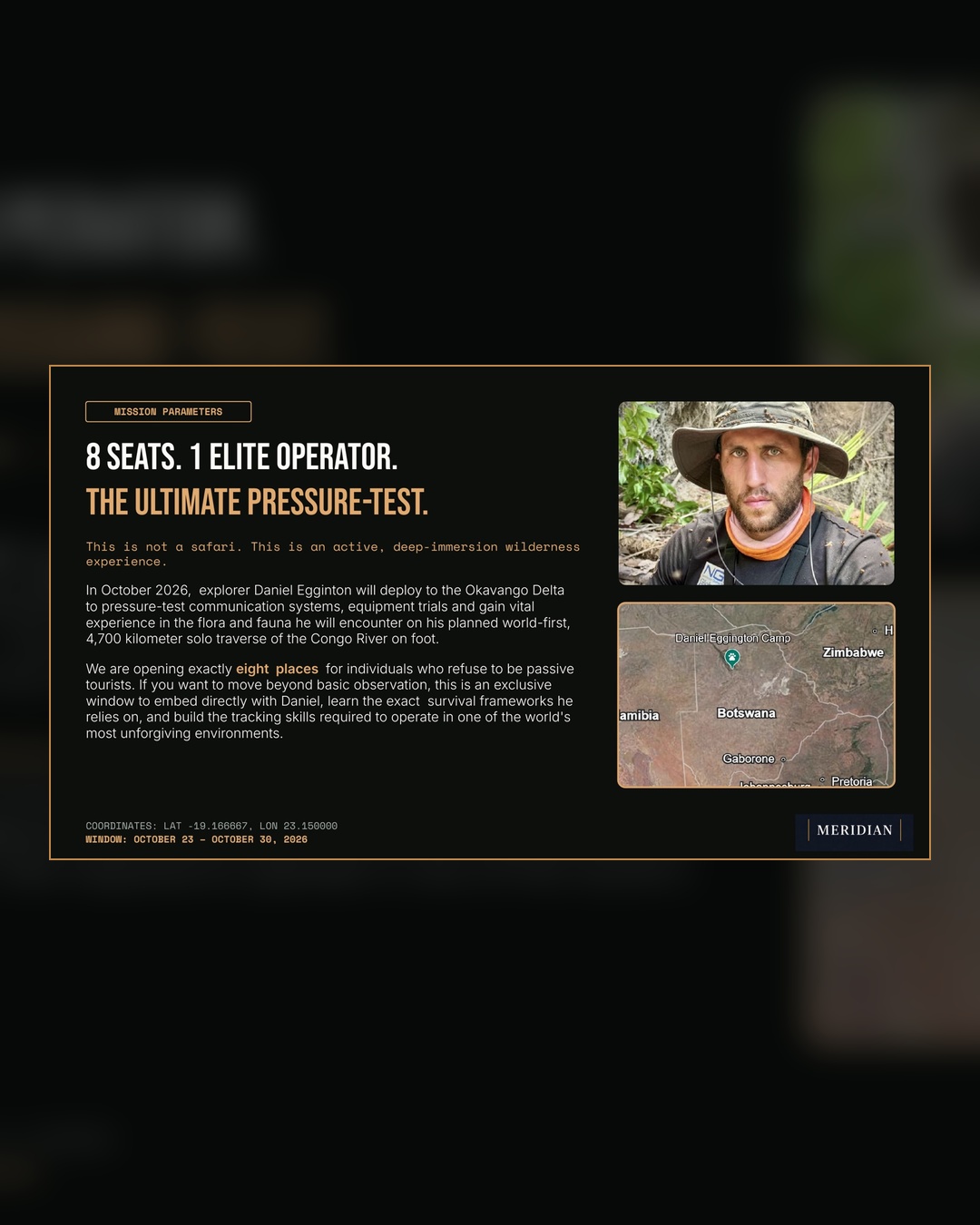
8 Seats. 1 Elite Operator.
The Ultimate Pressure-Test.
This is not a safari. This is an active, deep-immersion wilderness experience.
In October 2026, explorer Daniel Eggington will deploy to the Okavango Delta to pressure-test communication systems, run equipment trials, and gain vital experience in the flora and fauna he will encounter on his planned world-first, 4,700-kilometre solo traverse of the Congo River on foot.
We are opening exactly eight places for individuals who refuse to be passive tourists. If you want to move beyond basic observation, this is an exclusive window to embed directly with Daniel, learn the exact survival frameworks he relies on, and build the tracking skills required to operate in one of the world's most unforgiving environments.
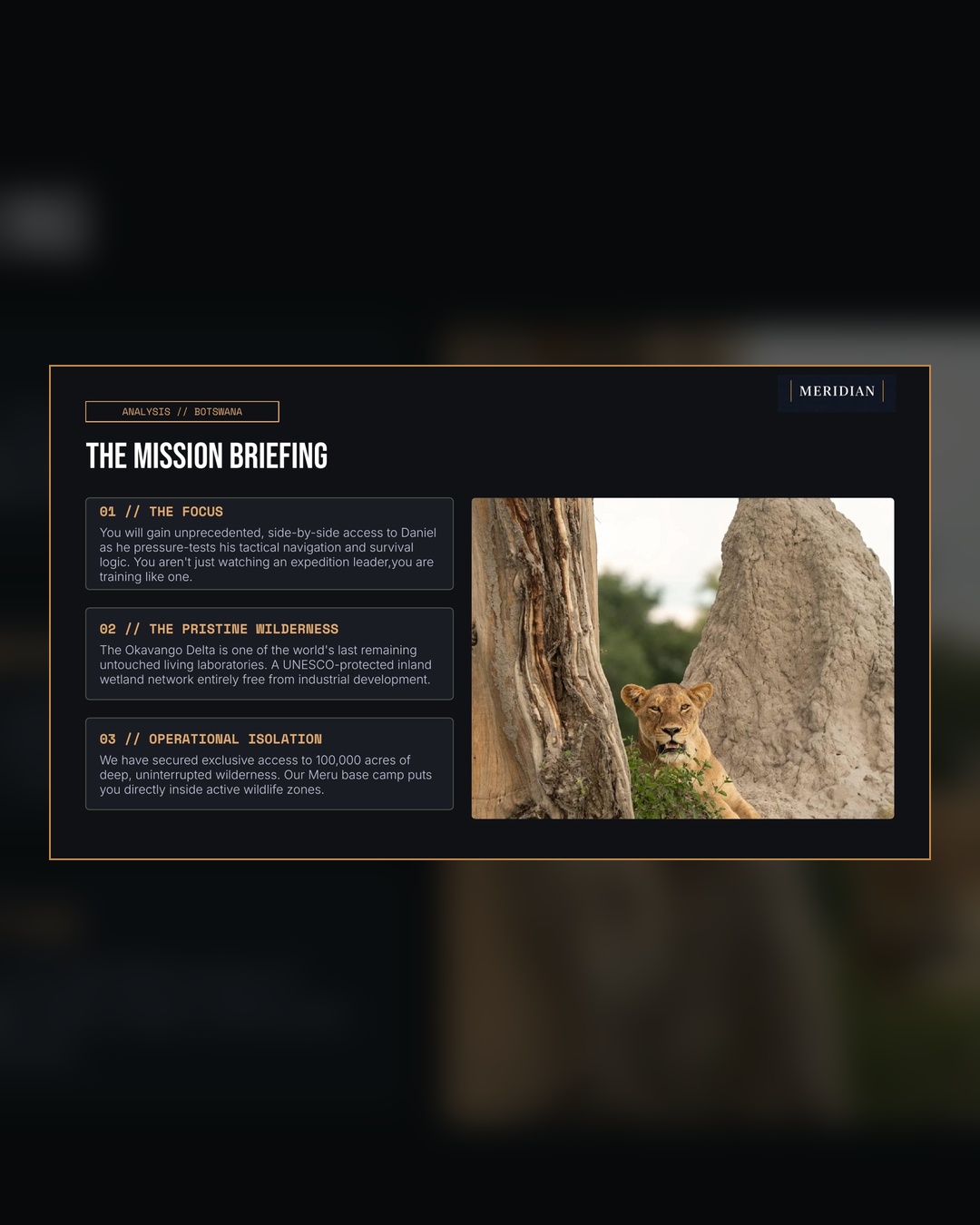
The Mission Briefing
You will gain unprecedented, side-by-side access to Daniel as he pressure-tests his tactical navigation and survival logic. You aren't just watching an expedition leader — you are training like one.
The Okavango Delta is one of the world's last remaining untouched living laboratories. A UNESCO-protected inland wetland network entirely free from industrial development.
We have secured exclusive access to 100,000 acres of deep, uninterrupted wilderness. Our Meru base camp puts you directly inside active wildlife zones.
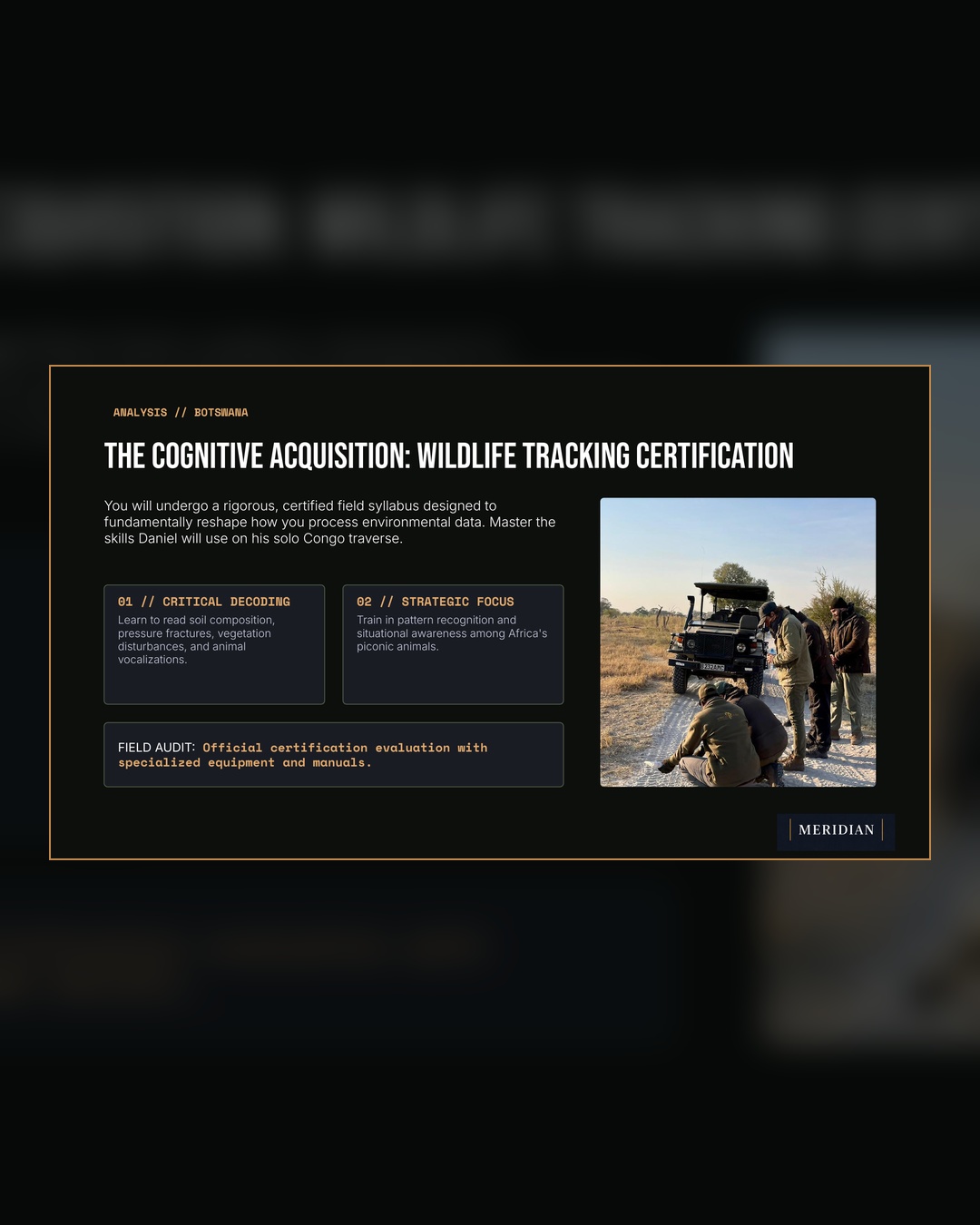
The Cognitive Acquisition: Wildlife Tracking Certification
You will undergo a rigorous, certified field syllabus designed to fundamentally reshape how you process environmental data. Master the skills Daniel will use on his solo Congo traverse.
Learn to read soil composition, pressure fractures, vegetation disturbances, and animal vocalizations.
Train in pattern recognition and situational awareness among Africa's iconic animals.
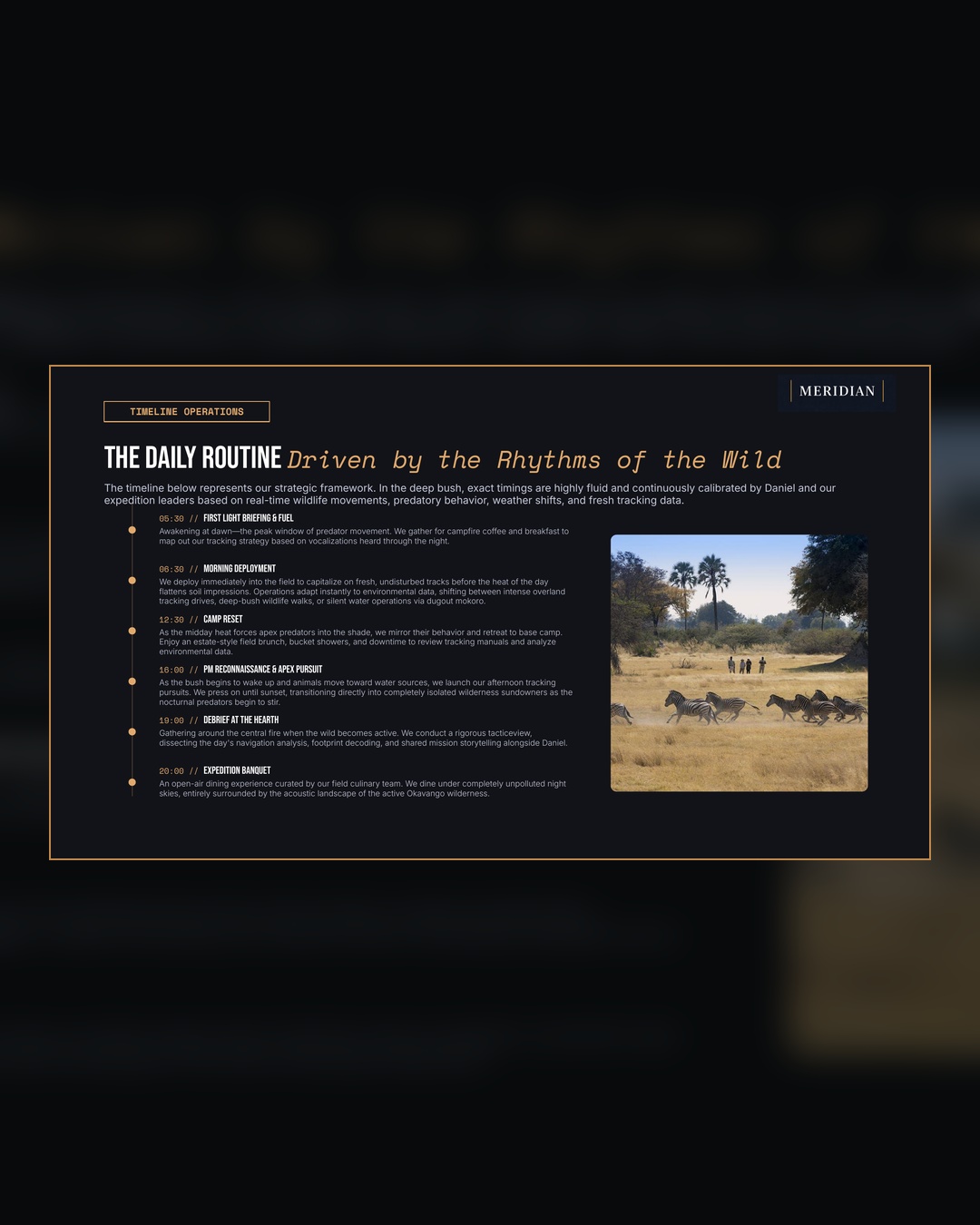
The Daily Routine Driven by the Rhythms of the Wild
The timeline below represents our strategic framework. In the deep bush, exact timings are highly fluid and continuously calibrated by Daniel and our expedition leaders based on real-time wildlife movements, predatory behaviour, weather shifts, and fresh tracking data.
- 05:30 // First Light Briefing & Fuel
Awakening at dawn — the peak window of predator movement. We gather for campfire coffee and breakfast to map out our tracking strategy based on vocalizations heard through the night.
- 06:30 // Morning Deployment
We deploy immediately into the field to capitalize on fresh, undisturbed tracks before the heat of the day flattens soil impressions, shifting between overland tracking drives, deep-bush wildlife walks, or silent water operations via dugout mokoro.
- 12:30 // Camp Reset
As the midday heat forces apex predators into the shade, we mirror their behaviour and retreat to base camp. Enjoy an estate-style field brunch, bucket showers, and downtime to review tracking manuals.
- 16:00 // PM Reconnaissance & Apex Pursuit
As the bush wakes and animals move toward water, we launch our afternoon tracking pursuits — pressing on until sunset and transitioning into isolated wilderness sundowners as the nocturnal predators stir.
- 19:00 // Debrief at the Hearth
Gathering around the central fire when the wild becomes active. We conduct a rigorous tactical review, dissecting the day's navigation analysis, footprint decoding, and shared mission storytelling alongside Daniel.
- 20:00 // Expedition Banquet
An open-air dining experience curated by our field culinary team. We dine under completely unpolluted night skies, surrounded by the acoustic landscape of the active Okavango wilderness.
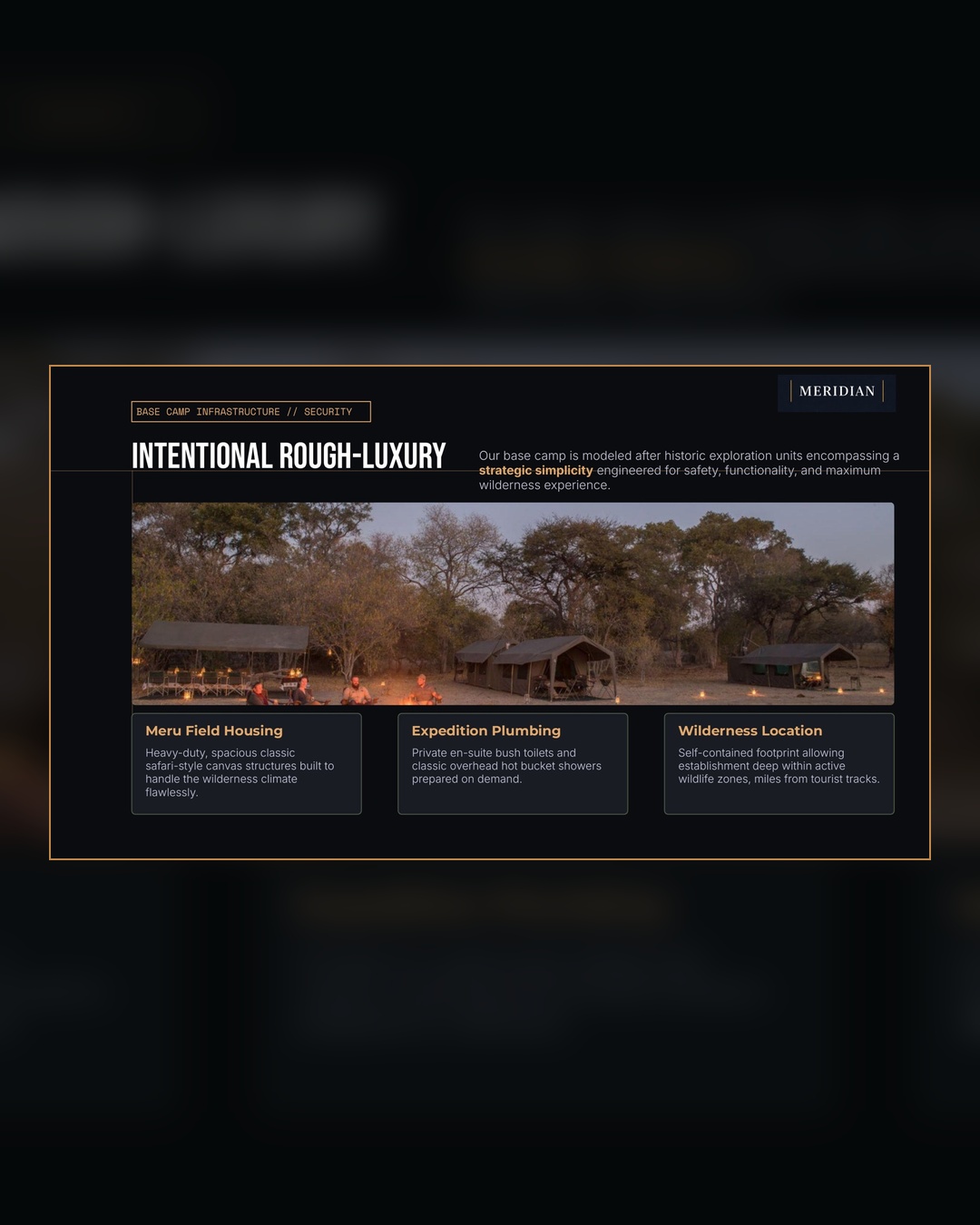
Intentional Rough-Luxury
Our base camp is modelled after historic exploration units, encompassing a strategic simplicity engineered for safety, functionality, and maximum wilderness experience.
Heavy-duty, spacious classic safari-style canvas structures built to handle the wilderness climate flawlessly.
Private en-suite bush toilets and classic overhead hot bucket showers prepared on demand.
Self-contained footprint allowing establishment deep within active wildlife zones, miles from tourist tracks.
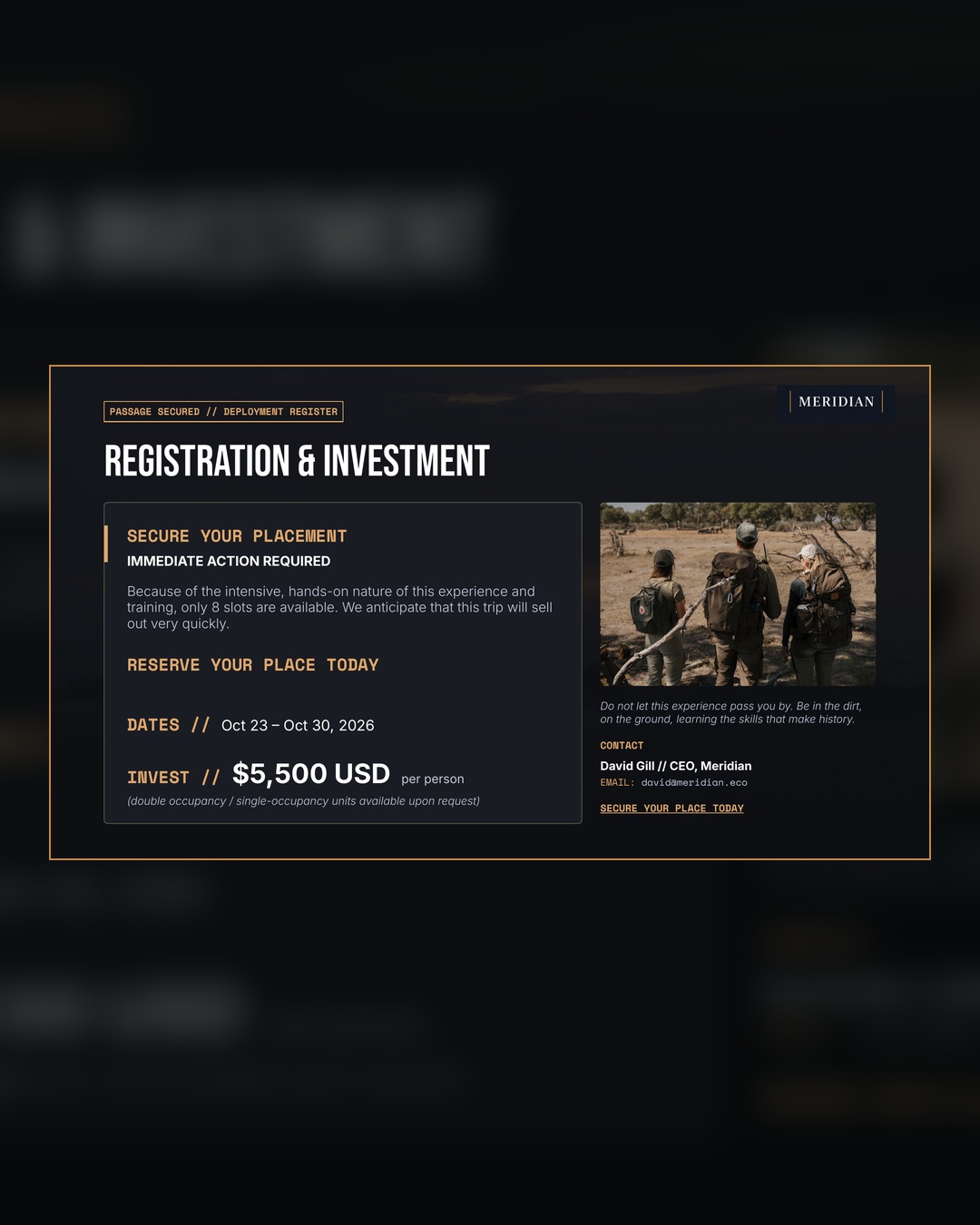
Registration & Investment
Because of the intensive, hands-on nature of this experience and training, only 8 slots are available. We anticipate that this trip will sell out very quickly.
(double occupancy / single-occupancy units available upon request)
Do not let this experience pass you by. Be in the dirt, on the ground, learning the skills that make history.
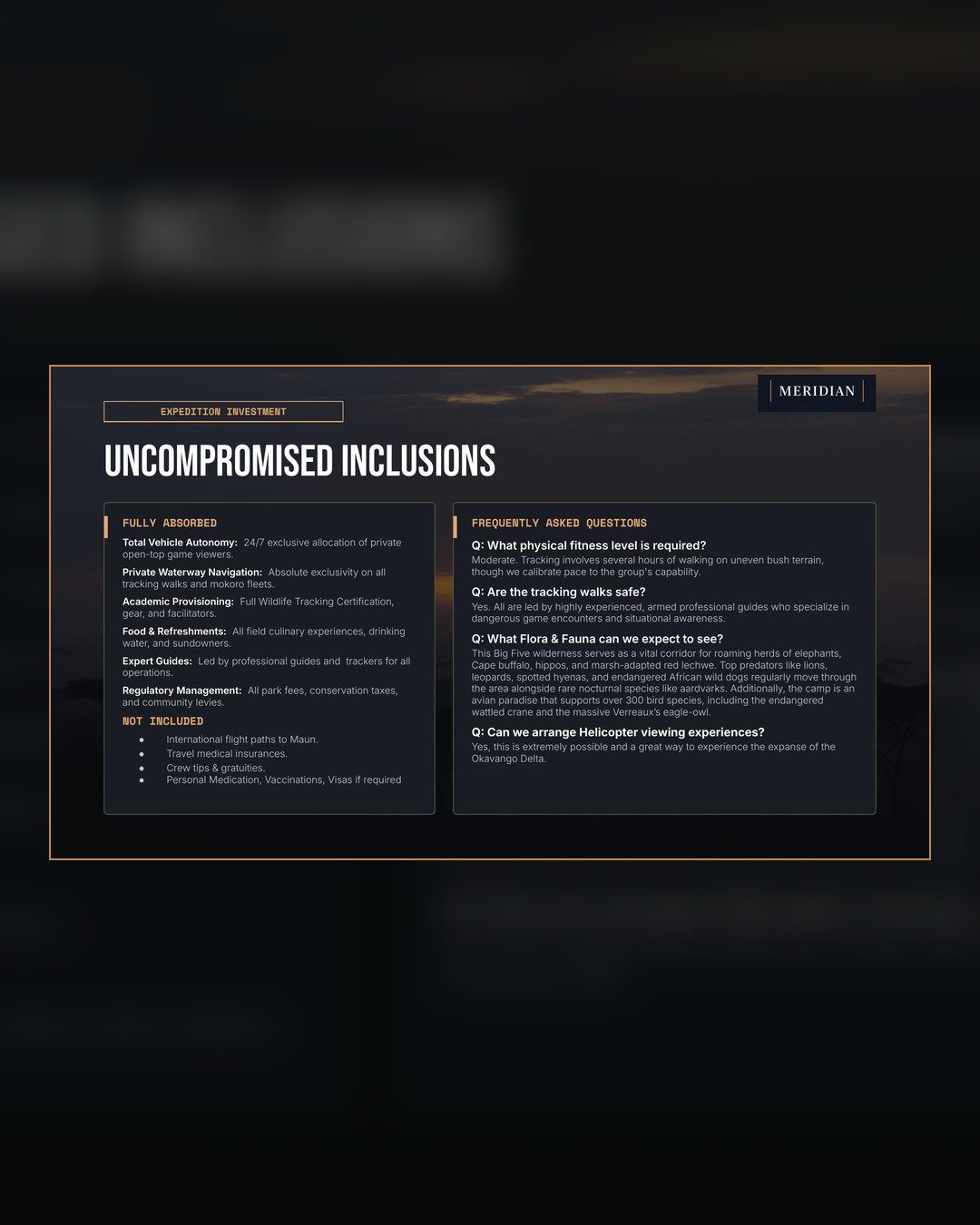
Uncompromised Inclusions
- Total Vehicle Autonomy: 24/7 exclusive allocation of private open-top game viewers.
- Private Waterway Navigation: Absolute exclusivity on all tracking walks and mokoro fleets.
- Academic Provisioning: Full Wildlife Tracking Certification, gear, and facilitators.
- Food & Refreshments: All field culinary experiences, drinking water, and sundowners.
- Expert Guides: Led by professional guides and trackers for all operations.
- Regulatory Management: All park fees, conservation taxes, and community levies.
- International flight paths to Maun.
- Travel medical insurances.
- Crew tips & gratuities.
- Personal medication, vaccinations, visas if required.
Moderate. Tracking involves several hours of walking on uneven bush terrain, though we calibrate pace to the group's capability.
Yes. All are led by highly experienced, armed professional guides who specialize in dangerous game encounters and situational awareness.
This Big Five wilderness serves as a vital corridor for roaming herds of elephants, Cape buffalo, hippos, and marsh-adapted red lechwe. Top predators like lions, leopards, spotted hyenas, and endangered African wild dogs move through the area alongside rare nocturnal species. The camp is an avian paradise supporting over 300 bird species.
Yes — this is extremely possible and a great way to experience the expanse of the Okavango Delta.
October 23 – 30, 2026 · Okavango Delta, Botswana
Okavango Delta FAQ
The detail behind the deployment — logistics, climate, health, and exactly how we keep eight people safe in active Big Five wilderness.
8 days, October 23–30, 2026, in a private wilderness concession in Botswana's Okavango Delta. We rendezvous in Maun; road and/or light-aircraft transfer to base camp is coordinated on arrival.
Fly internationally into Maun (MUB) via Johannesburg, Cape Town, or Windhoek. We confirm transfer timings once your place is secured. International flights to Maun are not included.
A hard cap of eight participants plus Daniel, professional guides, trackers and camp crew. We do not combine with other groups.
Moderate. Expect several hours of walking on uneven, sandy and sometimes hot terrain, plus early starts. Pace is calibrated to the group, but you should be comfortable on your feet for half-day stretches.
Hot and dry — the pre-rains build-up. Daytime highs can reach the mid-30s°C, cooler mornings and evenings. Wildlife concentrates around shrinking water, which is exactly why we deploy in this window.
The Delta is a malaria-risk area; prophylaxis is strongly advised. Consult a travel clinic 6–8 weeks before departure for malaria, routine and any required vaccinations. Yellow-fever proof may be required depending on your routing.
Yes — mandatory. You must hold travel medical insurance that includes wilderness emergency medical evacuation. Proof is required before deployment.
A certified field syllabus in wildlife tracking and environmental reading — soil and pressure analysis, sign interpretation, situational awareness — assessed in the field with manuals and equipment provided.
Big Five corridor: elephant, buffalo, hippo, lion, leopard, spotted hyena and endangered wild dog, plus red lechwe and 300+ bird species. Sightings are wild and never guaranteed, but the concession is exceptional.
Yes — optional helicopter experiences over the Delta can be arranged at additional cost. Flag your interest on the registration form.
Pre-Deployment Safety Checklist
Confirm every item below before you travel. Items marked MANDATORY are non-negotiable conditions of joining the deployment.
Including wilderness emergency evacuation cover. Proof required.
Valid for at least 6 months beyond return, with blank pages for stamps.
Check Botswana entry requirements for your nationality before booking flights.
Prescribed by a travel clinic; start course as directed.
Routine boosters current; yellow-fever certificate if your routing requires it.
Book 6–8 weeks before departure for tailored health advice.
Carry sufficient supply in hand luggage, plus a basic personal kit.
Share next-of-kin details and any medical conditions/allergies with us in advance.
Neutral, lightweight long sleeves/trousers, sun hat, broken-in walking boots, warm layer for mornings.
High-SPF sunscreen, sunglasses, and DEET-based repellent.
Be prepared for hot, dry conditions; we supply drinking water throughout.
Read and agree to the on-arrival safety briefing and guide instructions.
Eight places · October 23–30, 2026 · Okavango Delta, Botswana